|
|
|
OLVIDAR
ES MORIR
Reference
is made to a peculiar and now fashionable practice within cities across Brazil:
in
these, people interested in
declaring their love, affection, friendship or any other feelings towards others,
do so by means of cotton they
commission from specialised companies.
These
banner “products” have a standardised look: all bear composed phrases
written along horizontally and diagonally disposed lines in juxtaposition,
mixing typography and colours in the process.
What
interests me in this procedure and constitutes the focal aspect leading to
“Olvidar es Morir” – To Forget Is To
Die – is the ambiguity contained within a statement, which, in being made
public, is pretentiously intended unconditional.
Along
the virtuous strokes of a banner painted by a third party, someone who open
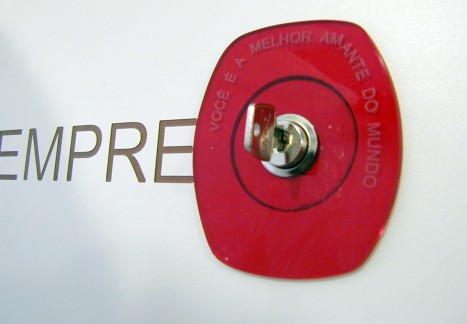
heartedly states “Jill, you are the best lover in the world” may pretend to
be in a state of having nothing to conceal and to be asking for nothing in
return.
The
public at large will be allowed to know that “you Jill are the best lover in
the world” while I the author, remain hidden in the safe haven of anonymity
warranted by the hand painted strokes of someone else.
Then
again, however, this apparent detachment is poor at concealing the crippling and
shameless intention of someone whose aim, clearly, is the entrapment of his or
her beloved one in a network of notoriety and fame.
This
specific visual media, which involves commerce and publicity of subjective
feelings, has the power to seal the imagination of the one desired, aside from
keeping him or her distant from the public who after being exposed to the
message more than once foresees that “Jill” has lost.
The
greeting banner operates, in its own way, like a “woodu”; while
contemplative gazing by the public rests time and again on “Jill’s qualities
and specificities, the result is the ultimate dismissal of her attributes.
“Olvidar
es Morir” is an allegory of such a relationship.
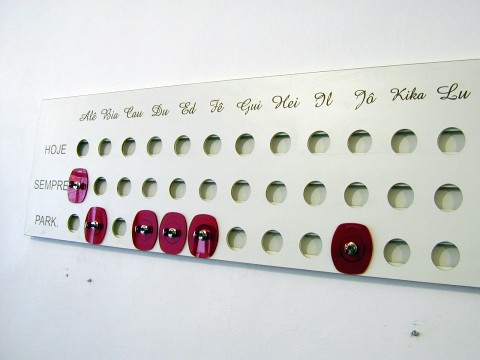
Homage
is made when a self-locking message chosen from a parking area (Park.) is grid
locked at the intersection formed by a name and a temporal reference (Hoje:Today,
Sempre:Forever)
Once
the message is trapped, the author takes the key away.
In doing so, he not only gains possession of a situation which is
significant to him but that is also contained within the art piece.
Once 24 people
(number of padlocks) have gone through this process, the piece will acquire a
‘definitive’ transitory shape...
For
the La Habana Biennal period there is no possibility of taking the key away. It
will be to each person to maintain the image of when he was able to capture
someone's soul.
PATRICIA FURLONG
PERSONAL
INFORMATION
BORN 1955, PORTO ALEGRE, BRASIL
EDUCATION
GRADUATED FROM DEPARTMENT OF ARTS, FUNDAÇÃO ARMANDO ÁLVARES PENTEADO,
SÃO PAULO, BRASIL
TEACHING
EXPERIENCE
1998 - OSWALD DE ANDRADE CULTURAL WORKSHOPS, SÃO PAUO
1997 - OSWALD DE
ANDRADE CULTURAL WORKSHOPS, SÃO PAULO
1995 - SÃO
PAULO MODERN ART MUSEUM, SÃO PAULO
1991- ALFREDO ANDERSEN ART MUSEUM, CURITIBA
OSWALD DE ANDRADE CULTURAL WORKSHOPS, SÃO PAULO
1984 - NATIONAL SERVICE OF COMMERCE (SENAC), SÃO PAULO
SOLO EXHIBITIONS
1993 -MUSEUM OF MODERN ART, SÃO PAULO
1992 - SÃO
PAULO ART GALLERY, SÃO PAULO
1989 - KRAMER ART GALLERY, SÃO PAULO
1988 - SADALLA ART GALLERY, SÃO PAULO
ARTE&FATO ART GALLERY, PORTO ALEGRE
1987 - LYNGBY KUNSTFORENING, KOPENHAGEN, DENMARK
CASA DO BRASIL ART GALLERY, ROME, ITALY
GROUP EXHIBITIONS (SELECTED)
2002 -
PINACOTECA DO ESTADO, SÃO PAULO
2001 - PAÇO DAS
ARTES, SÃO PAULO
2000 - VII HABANA INTERNATIONAL BIENNALE, HABANA,
CUBA
UNIVERSITY ART MUSEUM, UBERLÂNDIA
DRAGÃO
DO MAR ART CENTER, FORTALEZA
MUSEUM OF CONTEMPORARY ART , NITERÓI
1999 - MUSEUM OF MODERN ART, SÃO PAULO
METROPOLITAN ART MUSEUM, CURITIBA
ESPAÇO
DOS CORREIOS, RIO DE JANEIRO
MARINA POTRICH ART GALLERY, GOIÂNIA
NARA
ROESLER ART GALLERY, SÃO PAULO
1996 - HUMBERTO
PRIMO, SÃO PAULO
PAÇO DAS ARTES, SÃO PAULO
MUSEUM OF CONTEMPORARY ART , SÃO PAULO
SESI ART GALLERY, SÃO PAULO
1995 - MADISON MEMORIAL UNION, WISCONSIN, EUA
1994 - SÃO PAULO ART GALLERY
RENATO MAGALHÃES GOUVÊA ART GALLERY
1993 - FUJITA
VENTE MUSEUM, TOKYO, JAPAN
1989 - SANTA
CATARINA ART MUSEUM, FLORIANÓPOLIS
MONTESANTI ART GALLERY
1987 - MUSEUM OF MODERN ART, SÃO PAULO
SADALLA ART GALLERY
PAÇO DAS ARTES, SÃO PAULO